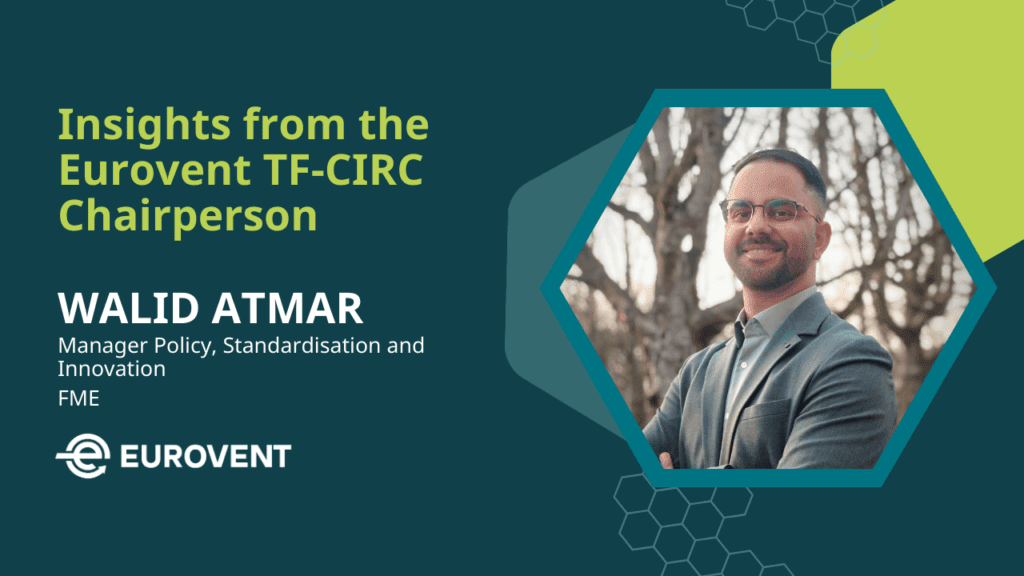
Walid Atmar was recently elected as the Chairperson of the Eurovent Task Force ‘Circularity’ (TF-CIRC). He is also the Manager of Policy, Standardisation and Innovation at Binnenklimaat Nederland. In this interview, he sheds some light on the activities of the TF-CIRC.
What are your main priorities for the task force during your Chairmanship?
One of my main priorities is to help the Eurovent Task Force ‘Circularity’ develop a clear and pragmatic industry perspective on standardisation of circularity requirements for HVACR products.
Circularity is becoming a core element of European product policy. New frameworks such as the Ecodesign for Sustainable Products Regulation (ESPR) will introduce requirements related to durability, repairability, recyclability, recycled content and digital product information. These developments will directly affect HVACR manufacturers in the coming years.
At the same time, circularity is increasingly and rapidly appearing in national policies and public procurement strategies, meaning that the effects are already being felt by manufacturers across Europe. This growing regulatory landscape makes it even more important to work toward a clear and pragmatic European framework that supports circularity while avoiding unnecessary complexity and regulatory burden for the industry. Manufacturers face increasing regulatory pressure from multiple parallel policy initiatives across Europe.
The HVACR manufacturing industry must be properly represented in the circularity debate. Too often, discussions about circularity take place without sufficient involvement of manufacturers, even though they are the ones designing and producing these products. The task force should therefore help ensure that the industry is recognised as a key stakeholder in policy development and that Eurovent can contribute a coherent and realistic perspective that balances ambitious sustainability goals with technical feasibility and market realities.
What are the key objectives of the task force, and why is circularity becoming increasingly important for the HVACR sector?
Personally, I would say that circularity is not just becoming important for the HVACR sector; it already is. Let me start with some observations to underline the importance.
We are increasingly seeing that national circular economy agendas and standards set expectations for how HVACR products should be designed, maintained and operated. When different countries apply different standards or policy expectations, the industry risks losing the advantages of scale that normally support product design and R&D. Manufacturers may then have to adapt products to multiple national approaches instead of developing solutions for a unified European market. This is why there is a clear need for Europe to step up and provide guidance to Member States, helping to harmonise these efforts. A coherent European framework would allow R&D strategies to be implemented more efficiently and effectively across the European market.
Another observation I often make is that when we talk about the circular economy, we sometimes forget half of the term: the economy part. We tend to focus strongly on circularity from an environmental perspective, which is understandable, but the economic dimension is equally important for the viability of the industry. As we move away from linear economic models, we see new actors and new forms of collaboration emerging that extend the life of HVACR products, either during the use phase or at the end of their lifecycle. This raises important questions about the business models of our sector, which have traditionally been centred around bringing new products to the market. The industry needs to anticipate these developments and adapt accordingly.
Closely related to this is the question of responsibilities within the value chain. Many HVACR products are complex systems made up of components and sub-assemblies. In discussions about circularity, it is therefore important for the HVACR sector to have a clear vision of where the responsibilities of manufacturers begin and end. At the moment, these boundaries are often not well defined, which can lead to expectations that are not always balanced or realistic.
Finally, recent events such as the COVID-19 crisis and the ongoing geopolitical developments have exposed vulnerabilities in global supply chains and highlighted Europe’s dependence on strategic and critical raw materials. Policymakers increasingly see circularity as a way to strengthen European value chains and reduce resource dependency. This adds another dimension to the circularity debate that is highly relevant for the HVACR industry.
Taking these developments in mind, the key objective of the Eurovent Task Force Circularity is to bring together the expertise of the HVACR manufacturing industry and translate it into a coherent and pragmatic European perspective on circularity. In doing so, we aim to help strike the right balance between sustainability ambitions, technical feasibility and regulatory burden. That can be done by:
- Monitoring and analysing European circularity policies and assessing their relevance for HVACR products and systems.
- Bringing together manufacturers and industry experts to develop a coherent industry perspective on circularity. By exchanging knowledge and experiences, the group works towards common principles and guidance that reflect the technical realities of HVACR products and support Eurovent’s broader policy positions.
- Gathering the knowledge and working together with Eurovent’s product groups. Many of these groups are addressing circularity topics within their specific sectors, and the task force helps translate this expertise into an overarching industry-wide perspective.
- Providing technical input to policymakers to ensure that circularity requirements remain workable for complex HVACR systems with long lifetimes and integrated components. In this way, industry’s expertise can contribute to regulations that are both environmentally meaningful and technically feasible.
- Supporting greater harmonisation across Europe by contributing to a shared industry perspective on circularity. This helps avoid fragmented national approaches and supports the development of a more coherent regulatory framework for the HVACR sector.
The strength of our industry lies in innovation. It is therefore important to ensure that increasing regulatory and administrative requirements do not come at the expense of the industry’s ability to innovate and develop new solutions, which are critical to achieving sustainable goals.
How can the work of the task force help manufacturers and policymakers accelerate the transition toward more circular HVACR products and systems?
So far, we have talked about several themes that illustrate why circularity is such an important topic for the HVACR sector. To answer this question, it is useful to briefly put ourselves in the position of both policymakers and manufacturers, because the transition towards a circular economy ultimately requires cooperation between both.
From the perspective of policymakers, circularity policies are developed with the intention of creating a greener and more sustainable Europe. As an industry, we should demonstrate that we are willing to take our responsibility and act as a constructive partner in that transition. At the same time, it is important that we clearly communicate what the industry needs in order to implement circularity effectively. At the moment, what manufacturers often need most is clarity, predictability and direction. The task force can contribute by facilitating a structured dialogue with policymakers and by bringing in the technical expertise of the industry. In doing so, we can help ensure that policies remain practical, proportionate and effective, while maintaining the right balance between sustainability ambitions and technical feasibility. The task force should therefore aim to be a constructive discussion partner that does not seek to slow down progress but helps guide it in the right direction.
From the perspective of manufacturers, expectations are increasing rapidly. Companies are expected to develop circular products in an environment where circularity principles are still evolving and where methodologies are not yet fully standardised. This places manufacturers in a difficult position, especially when expectations differ between national markets. A good example is the current situation around Environmental Product Declarations (EPDs), where different national approaches can lead to fragmentation and high costs for manufacturers. This is where the task force can help. By bringing together expertise from across the HVACR industry, the task force can help translate complex policy developments into practical insight for companies. It can help identify where circularity requirements are heading, what timelines manufacturers should anticipate, and how companies can prepare their products, R&D strategies and supply chains accordingly.
In addition, the task force can help align experiences from different manufacturers and work together with the Product Groups, turning individual challenges into collective industry knowledge. Instead of every company trying to interpret regulatory developments on its own, the task force provides a platform where members can exchange insights and work towards common positions.
Ultimately, the task force should help provide direction and predictability for manufacturers in a rapidly evolving policy landscape. By advocating for greater harmonisation and standardisation across Europe, while also clarifying how circularity requirements may evolve, the task force can help companies invest their resources most efficiently and effectively. This enables manufacturers to continue doing what they do best: innovating and developing HVACR products that contribute to a healthy indoor climate in a sustainable built environment.